![Alaska Housing Finance Corporation [Logo]](/application/themes/ahf2/images/logo.png?v=2)
A Place to Sleep, a Chance to Be a Kid Again

On a winter night in Alaska, the cold has a way of magnifying everything; fear, uncertainty, exhaustion. For adults experiencing homelessness, the challenges are immense. For children, they can be overwhelming.
A warm bed, a quiet place to do homework, a door that locks at night; these are not luxuries, they are foundations. And yet, for many Alaska families those foundations can disappear quickly due to domestic violence, economic shocks or a lack of available housing.
Through Alaska Housing Finance Corporation’s Housing Stabilization & Recovery, thousands of Alaskans found a bridge from crisis to stability. Among them are children whose lives have been reshaped not just by housing assistance but by the restoration of safety, routine and hope.
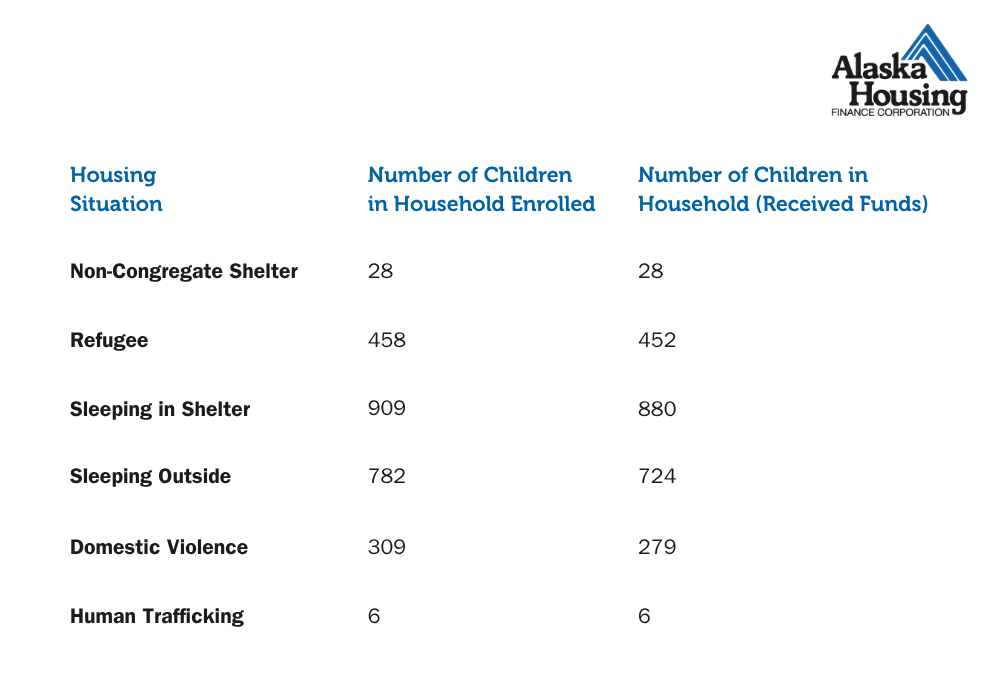
At the sunset of this program, Sept. 30, 2025, roughly one quarter of households served included children younger than the age of 18 – a total of 2,369. Behind that number are young people who have slept in shelters, cars or temporary spaces and who now have the opportunity to be kids again.
Meeting Families Where They Are
AHFC’s Stabilization & Recovery was born of innovation and critical thinking during a moment of transition. As Alaska Housing’s federally funded emergency Rent Relief came to a close, AHFC recognized a critical housing gap: families and individuals facing immediate homelessness still needed help that was not months away but right away. AHFC’s Stabilization & Recovery stepped into that moment with speed and compassion, prioritizing safety first and stability next.
“We designed Stabilization & Recovery to respond to urgency,” says Bryan Butcher, AHFC Executive Director.
“At program entry, more than 40% of households were sleeping outside or in shelters, and many were fleeing domestic violence, trafficking or displacement. For families with children, delays in assistance can mean prolonged trauma; therefore, the program prioritized immediate access to housing as a first and deeply human step toward long-term stability.”
Using the flexibility of one-time U.S. Treasury Emergency Rental Assistance funding, AHFC set out to design a program that could respond to present day realities impacting communities across the state. The result was an approach that met people where they lived — on streets, in emergency shelters or fleeing domestic violence, and it offered immediate housing paired with up to 12 months of rental assistance, as well as additional support that would result in better outcomes around their stability including moving expenses and rental deposits.
“We didn’t start from scratch, we leveraged our relationships with trusted community nonprofit partners who were already doing this work, walking alongside families in their hardest moments,” says Daniel Delfino, Director, AHFC Planning & Program Development.
“Stabilization & Recovery gave us the flexibility to stand with them, to listen, to test strategies and implement changes. That collaborative evolution helped create a program with meaningful, lasting impact.”
For children, this response meant the difference between continuing a cycle of displacement and instead finding a path of security.
The Power of Stability
Within the program launch in February 2022 and its sunset in September 2025, housing navigators enrolled 4,241 households across Alaska. Too many included children who had known instability far too early in life. As of August 2025, 3,697 people exited the program after achieving self-sufficiency or transitioning to longer-term housing.
Those numbers reflect something deeper than program success. They represent children able to sleep through the night without fear of being uprooted again and the stability to return to school consistently. This stability gave parents space to be caregivers rather than crisis managers. And it gave families time — time to heal, to connect with resources and to rebuild.
Housing Navigators: Anchors in the Storm
At the heart of the program were housing navigators who were trained professionals working for 28 AHFC’s nonprofit partners in more than 20 communities. They were often the first contact for families in crisis, conducting quick intakes through street outreach, shelter visits or from referrals.
Using a custom-built online application, navigators enrolled clients in minutes, capturing essential information on a tablet and sharing it in real time with AHFC and partner organizations. This time-saving tactic was critical to the program overall but especially when children were involved.
Once a family was stabilized, navigators continued to work with them, helping locate longer-term housing including applying for public housing waitlists, connecting families to available emergency vouchers or coordinating with other community programs. For parents, that continuity helped to build trust. For children, it helped create a sense that someone cared and journeyed alongside their family rather than just checking a box and moving on.
A Statewide Commitment
Stabilization & Recovery impacted communities across Alaska, including Anchorage, Juneau, Petersburg, Fairbanks and Prince of Wales. Each community brought its own challenges but the goal remained the same: get people off the streets, out of shelters and into housing where they can begin to stabilize.
Housing status before program entry:
- 43% sleeping in shelter
- 41% sleeping outside
- 7% victim of domestic violence
- 1% victims of trafficking
- 9% refugee
- 28% children (overall)
Eligibility was intentionally flexible. Families did not need to document income, criminal history or credit scores. What mattered most was need, whether that be sleeping outside, staying in a shelter or escaping violence or trafficking.
For children, this approach removed barriers that too often delay help. It ensured that safety and stability was not withheld while paperwork caught up.
More Than a Roof
Housing alone does not erase trauma, but it creates conditions where healing can begin.
When children have a stable home, evidence shows they are more likely to succeed in school, maintain friendships and experience the predictability that supports healthy development. Parents, freed from the constant pressure of finding the next place to sleep, can focus on parenting, employment and long-term planning.
The people behind AHFC’s Stabilization & Recovery recognized that housing insecurity is not a single moment, it’s a spectrum. By addressing immediate needs while building pathways to longer-term solutions, the program offered families more than temporary relief; it offered a chance to reset.
Looking Forward
The impact of the program will extend far beyond its closure date — carried forward in the lives of children who now associate home with safety instead of fear.
For every statistic, there is a child whose story quietly changed. A child who, with the right support at the right time, was given the chance to grow up with stability as their starting point.
That is the heart of Housing Stabilization & Recovery — and the future it helped build for Alaska’s families, adults and children alike.
Established Housing Stabilization & Recovery Eligibility Criteria:
- Household must have been under 80% of Area Median Income
- Individuals must have been facing any of the following circumstances:
- Living on the street
- Sleeping in an emergency shelter
- Escaping domestic violence or human trafficking