![Alaska Housing Finance Corporation [Logo]](/application/themes/ahf2/images/logo.png?v=2)
AHFC’s Innovative Housing Initiative Gains Ground Meeting Community Needs
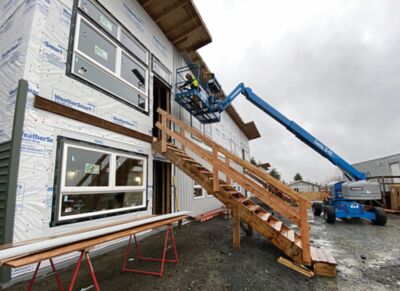
In Alaska the term “rural” isn't just a label, it's a lifestyle that shapes our communities and experiences in ways those from outside the state may not fully appreciate. More than 80% of our communities have fewer than 1,000 residents. More than half our land mass, which is twice the size of Texas, is only accessible by plane or boat and some villages require riding a four-wheeler or snow machine after the boat or plane lands. These communities still need access to housing but many lack the capacity to take advantage of existing housing programs and are unable to expand their inventory because there are no specialized systems or workforce locally accessible even when funding is available.
Statewide Concern
In early 2023, Alaska Housing Finance Corporation surveyed state agencies to gather data and pinpoint specific communities struggling to recruit and retain workers due to housing shortages. A common thread was soon identified:
- Due to a lack of housing, many positions essential to the community’s economic vitality are unfilled.
- Airport crews, public safety officers, healthcare workers, maintenance staff, judges and other critical professionals are struggling to find housing of any type, and sometimes end up sleeping on floors.
- Demand for housing is so extreme, properties are purchased sight-unseen before they even go on the market.
This data became the springboard for the Last Frontier Housing Initiative that connects AHFC staff, systems and infrastructure with rural community partners to help build housing.
Collaborative Solutions
A combination of federal and state funds allowed AHFC to embark on a once-in-a-generation opportunity to incentivize local governments in Western and Southeast Alaska with incentives for new housing construction.
To jumpstart housing builds, AHFC offered to be a design-build partner with local governments in five of the most remote communities in the United States – Ketchikan and Sitka, on islands in Southeast, and Bethel, Nome and Kotzebue that are off the road system in Western Alaska.
The proposal was direct. Administered through a grant process, AHFC would award roughly $24 million in construction funding on a government-to-government basis with a simple proposition:
- The construction funding is yours if you choose to accept it;
- Where overlapping jurisdictions exist, i.e., borough/city/tribe, the community decides who leads;
- A minimum number of units will be built: some for state workers, others meeting federal affordable definitions;
- What is built, where and how is entirely a community call so long as minimum construction outcomes are met;
- Community partners must match AHFCs funding by at least 15% in cash, land, in-kind, etc.;
- AHFC staff will be available to help grant recipients navigate the programs, visit the communities and support their efforts by reviewing draft requests for proposals, helping with admin, grant tracking, etc. – anything required from start to finish.
Community Support
The response was nearly immediate with communities bringing their own innovative ideas to the table. With basic guidelines under the proposition leading the way, support provided by AHFC was tailored to meet individual community needs. Beyond funding, AHFC’s support fell within one of two broad categories.
1. Outreach
- AHFC staff went on-site to all five communities to meet with local elected leaders, tribal partners and community stakeholders for explanation and dialogue on the Last Frontier Housing Initiative.
2. Support
- AHFC provided support for all partners during the procurement phase.
- AHFC staff and technology supplemented the local partners' operations in several communities.
- AHFC provided programmatic guidance and on-site training to partners who were new to the program resources, setting them up for long-term success once the properties converted to the operations phase.
By May 2024, AHFC had visited all five communities and started signing funding agreements – with construction starting soon after.
“Consistent with AHFC’s past practices, we listened, we followed through, and we worked with our partners to build housing they were unable to build on their own." - Bryan Butcher, CEO/Executive Director, AHFC
Real Results
The Last Frontier Housing Initiative moved fast, exceeded unit expectations, came in under budget, and the first units are online.
- New units built (63) exceeded baseline expectations by 45%;
- $9.8 million in match funding beat projections by 173%;
- $584,000 costs per door were below models by 8%.
Due to the success of the Last Frontier Housing Initiative, in 2024, the Alaska Legislature created a new $4 million program with intent for AHFC to expand its housing partnerships with four statewide agency landholders to catalyze new housing developments, and it renewed the Last Frontier Housing Initiative. Both were supported by Governor Dunleavy.
“Structuring the Last Frontier Housing Initiative as a government-to-government partnership allowed AHFC to build and execute housing plans with our community partners rather than for them," said Butcher. "This buy-in and partnership enabled each of the five communities to leverage their respective strengths with AHFC’s resources to drive housing solutions most appropriate for their needs.”
Creating Opportunities
The success of the Last Frontier Housing Initiative is due in large part to AHFC’s diligent monitoring of allowable uses of restricted dollars, thought leadership and ingenuity, leveraging congressionally appropriated ERA-2 but expiring housing assistance with more flexible state resources. This diligence and creativity led to new resources allocated to continue work that is making a meaningful difference in housing construction statewide. The Phase I efforts including the original five communities paved the way for $22 million in additional resources to be deployed to seven new communities in Phase II of the Last Frontier Housing Initiative.
In September 2025, AHFC expanded the effort further, closing a deal with the University of Alaska to purchase land and property across the state for the purpose of future housing development.
“Our partnerships weren’t simply staff and funding driven. We engaged with communities and stakeholders individually to maximize outcomes, which included strategic work to build awareness, generate excitement and build accountability,” said Butcher.